
Written by Stephania S. | Relocation & Immigration, LaunchCy
Last updated: October 2026
If you are moving to Cyprus and considering living in Limassol, obtaining the right residence permit, finding a home and completing your immigration formalities are only the beginning.
The next step is discovering what it actually feels like to live here.
One of the biggest advantages of living in Limassol is how quickly the landscape changes once you leave the city. Within less than an hour, the Mediterranean coastline and modern cityscape can give way to vineyards, traditional stone-built villages, family wineries, pine forests, waterfalls and the foothills of the Troodos Mountains.
For newcomers, expats, families, professionals, founders and employees relocating to Limassol, October and November are two of our favourite months to explore this side of Cyprus.
The intense summer heat begins to ease. Hiking becomes much more comfortable. The grape harvest brings traditional foods such as palouzes and soutzoukos into focus. Villages celebrate wine, Commandaria and zivania, while cooler mountain weather makes long lunches in traditional Cypriot tavernas particularly enjoyable.
If you are still preparing your move rather than already living here, start with our complete guide to relocating to Cyprus, covering immigration, where to live, tax, healthcare, schools, property and the practical steps involved in establishing yourself on the island.
Relocating to Cyprus – Complete Guide for Individuals, Founders & Companies
For residence permits, EU registration, work permits, permanent residence and other immigration routes, see our dedicated Cyprus Immigration Services guide.
This article, however, focuses on what comes next: actually living in Cyprus.
These are some of the places, traditions and experiences around Limassol that we personally recommend to newcomers.
Why October and November Are Great Months to Explore Cyprus
Autumn is one of the most enjoyable periods for exploring Cyprus after the intense summer heat begins to ease.
Limassol can remain pleasantly warm during the day while temperatures in the higher villages and Troodos Mountains are considerably cooler.
That contrast is one of the pleasures of living here.
You can have breakfast beside the Mediterranean in Limassol and, later that same day, find yourself walking through a pine forest, tasting wine at a mountain winery or eating lunch in a stone-built village.
For somebody who has recently moved to Cyprus, autumn is particularly good for:
- exploring the Limassol wine villages;
- visiting Cyprus wineries;
- hiking in Troodos;
- discovering traditional Cypriot food;
- attending village festivals;
- tasting seasonal grape products;
- buying directly from local producers; and
- discovering rural Cyprus beyond the coast.
Always take comfortable walking shoes and an additional layer when heading into the mountains.
Limassol Wine Festival: Start Your Cyprus Wine Journey in the City
Before heading into the wine villages, there is one major Limassol tradition every newcomer should know about.
Limassol Wine Festival
The Limassol Wine Festival has been part of the city’s cultural calendar since 1961 and remains one of Limassol’s best-known annual events.
The festival takes place in the Limassol Municipal Gardens and celebrates Cyprus’s long connection with wine, food, music and traditional entertainment.
In 2026, the Limassol Wine Festival runs from 26 September until 4 October, with the Municipality of Limassol listing opening hours from 19:00 until midnight each evening.
Visitors can experience Cyprus wineries, food, open-air restaurants, music, dancing and cultural performances.
For somebody who has recently relocated to Limassol, we strongly recommend experiencing it at least once.
It is a great introduction to Cyprus wine culture before beginning to explore the actual vineyards and villages where much of that tradition originates.
Official Limassol Wine Festival – Municipality of Limassol
Explore the Limassol Wine Villages
One of the first weekend trips we recommend after moving to Limassol is exploring the traditional Krasochoria — literally the wine villages of Limassol.
The official Limassol Wine Route includes 20 villages and 16 wineries on the southern slopes of the Troodos Mountains. The route includes Lofou, Vouni, Koilani, Omodos, Vasa, Arsos, Pachna and Agios Amvrosios, among others.
Official Limassol Wine Villages Route – Visit Cyprus
Our advice is not to try to see every village in one day.
Choose three or four, add one winery and leave enough time for a proper Cypriot lunch.
That is a much better introduction to the region.
Omodos: One of the Best Wine Villages Near Limassol
Omodos is probably the best-known wine village in the Limassol district and one of the easiest introductions to rural Cyprus for somebody who has recently moved to the island.
Located around 42 km from Limassol at approximately 800 metres above sea level, Omodos is officially recognised for its wine, zivania and traditional arkatena bread. Its central square, cobbled streets, wineries and traditional stone buildings make it one of Cyprus’s most distinctive villages.
The village is particularly associated with:
- soutzoukos;
- palouzes;
- kiofterka;
- Commandaria;
- zivania;
- Cyprus wine; and
- traditional arkatena.
Our Omodos Recommendation: Arkatena Fotini
One place we particularly recommend is Arkatena Fotini – Fotini Bakery House.
Arkatena are one of Omodos’s most distinctive traditional foods.
Unlike ordinary bread made using commercial baker’s yeast, traditional arkateno uses a natural fermentation process based around chickpeas.
The result is a distinctive bread or rusk with a flavour and texture closely associated with Omodos.
What We Recommend Ordering
Don’t simply buy a packet of arkatena and leave.
Stay for breakfast.
We recommend trying the traditional arkatena together with a Cypriot breakfast of village sausage, eggs, anari, halloumi and homemade marmalades.
It is exactly the type of experience we recommend to newcomers: simple, authentic food that is directly connected to the village and its history.
And definitely take some arkatena home with you.
Lofou: Traditional Village Life, Mahalepi & Cyprus Coffee
If Omodos feels busy, Lofou offers a quieter experience.
The village’s stone architecture, narrow lanes and mountain setting make it ideal for a relaxed walk without needing a complicated itinerary.
Our Lofou Recommendation
Stop at the traditional kafeneio in the centre of the village.
Order a proper Cyprus coffee and, when available, try mahalepi.
Mahalepi is a light traditional Cypriot dessert usually served chilled and is one of those simple local foods newcomers may never discover if they only visit Limassol’s modern restaurants.
Sometimes the best village experience is simply sitting in the kafeneio, having a coffee and watching village life around you.
Vouni: Come for the Village, Stay for a Traditional Cyprus Meze
Vouni is another beautiful traditional wine village and works particularly well as part of a route combining Lofou, Vouni, Omodos and Koilani.
Its traditional houses, narrow streets and surrounding vineyards make it particularly atmospheric during autumn.
Our Vouni Recommendation: Takis Tavern
For lunch, we recommend Takis Tavern in Vouni.
Go hungry and order the traditional Cyprus meze.
A proper Cypriot meze is one of the best introductions to local food because instead of choosing a single main dish, you receive a succession of small dishes.
Expect dips, vegetables, cheeses and meats, with the meal gradually developing over several courses.
For somebody new to Cyprus, it is essentially an introduction to Cypriot cuisine one plate at a time.
As with many village tavernas, opening days can vary, so check before travelling.
Koilani: Wine Heritage & Vlassides Winery
Koilani has one of the strongest wine identities among the Limassol wine villages.
The surrounding countryside remains closely connected with vineyards and winemaking, making Koilani particularly easy to combine with a winery visit.
Our Koilani Recommendation: Vlassides Winery
Wine lovers should consider visiting Vlassides Winery.
The winery manages around 27 hectares of vineyards planted with both international and indigenous varieties.
Its Cypriot grapes include Xynisteri, Maratheftiko, Giannoudi and Promara, alongside varieties including Shiraz, Cabernet Sauvignon, Merlot, Sauvignon Blanc and Chardonnay.
For somebody who has recently moved to Cyprus and has only experienced local wine from restaurant menus, visiting a winery provides much more context.
You begin to understand the grape varieties, terroir and modern wine culture developing alongside Cyprus’s much older wine-making traditions.
Another Cyprus Winery We Recommend: Tsiakkas Winery
Another winery we particularly recommend is Tsiakkas Winery near Pelendri.
Tsiakkas was founded in 1988 and has increasingly focused on reviving and developing Cyprus’s indigenous grape varieties, including Yiannoudin, Promara and Xynisteri.
Its mountain location is one of the things that makes the winery particularly interesting.
Tsiakkas vineyards around Pelendri and Agros extend between approximately 700 and 1,440 metres above sea level. Its Petralona vineyard near Agros reaches 1,440 metres.
That altitude gives visitors a very different perspective on Cyprus viticulture compared with the warmer coastal landscape.
Our recommendation: book a proper tasting rather than simply stopping to purchase a bottle.
Vlassides and Tsiakkas are two excellent places to begin discovering how diverse modern Cyprus wine has become.
Cyprus Grape Harvest Traditions: Palouzes, Soutzoukos & Kiofterka
Autumn in the Cyprus wine villages is about much more than wine.
Traditionally, grapes have been transformed into an entire family of products that remain part of Cypriot food culture today.
What Is Palouzes?
Palouzes is a traditional Cypriot dessert made from grape must.
Fresh grape juice — known as moustos — is cooked and thickened until it develops a smooth, pudding-like consistency.
During autumn festivals, visitors can often see large quantities of palouzes being prepared traditionally.
If you encounter fresh palouzes during the grape season, try it.
What Is Soutzoukos or Siousioukos?
Soutzoukos, which you may also hear pronounced siousioukos in Cyprus, is one of the island’s most recognisable traditional sweets.
Almonds or walnuts are threaded onto a string and repeatedly dipped into thickened grape must.
Each layer is allowed to dry before another is added.
Gradually, it develops its characteristic elongated shape.
What Are Kiofterka?
Kiofterka are another traditional grape-must sweet.
The thickened grape mixture is spread out, allowed to set and dry and then cut into pieces.
You will often find kiofterka sold alongside soutzoukos in traditional village shops.
Commandaria: A Cyprus Tradition Every New Resident Should Know
Anybody moving to Cyprus should become familiar with Commandaria.
The historic sweet wine is made using Cyprus grape varieties and remains closely associated with the villages north of Limassol.
Cyprus has an official Commandaria Wine Route, one of seven designated wine routes promoted through the country’s official tourism programme.
Rather than simply ordering Commandaria after dinner, explore some of the villages associated with its production.
It gives you a much better understanding of why wine is such an important part of the cultural landscape surrounding Limassol.
Zivania: Cyprus’s Traditional Grape Spirit
Another important element of Cyprus grape culture is zivania.
The clear spirit is traditionally produced through distillation following the winemaking process.
During autumn festivals, visitors may also have the opportunity to see traditional distillation using a kazani.
For newcomers, it is one of the best examples of how the grape harvest historically produced much more than table wine.
Autumn Festivals Near Limassol: October & November 2026
Autumn festival season is one of our favourite times to explore rural Cyprus.
Festival dates can change each year, so always check official information before travelling.
Limassol Wine Festival – 26 September to 4 October 2026
The Limassol Wine Festival runs from 26 September to 4 October 2026 in the Limassol Municipal Gardens.
Kyperounta Apple Festival – 10–11 October 2026
The 22nd Kyperounta Apple Festival takes place on 10 and 11 October 2026.
The event has developed from a small community gathering into one of the better-known annual festivals in Cyprus’s mountain region, while retaining its connection with local agricultural production and village traditions.
Official Kyperounta Apple Festival 2026
Commandaria & Tradition Festival – 17–18 October 2026
One event we particularly recommend to newcomers is the Commandaria & Tradition Festival, taking place in Kalo Chorio on 17 and 18 October 2026.
The festival is dedicated to Commandaria and traditional products made from the grape harvest, including palouzes and siousioukos.
Visitors can participate in the preparation of palouzes, taste Commandaria and zivania and discover other traditional products such as halloumi, pisies and resi.
Official Commandaria & Tradition Festival 2026
Pelendri & the Zivania Tradition
Pelendri is particularly worth visiting during the autumn zivania season.
Combine a village visit with Tsiakkas Winery, traditional products and the wider Pitsilia region.
Explore Pitsilia
For a different landscape from the Limassol wine villages, continue higher towards Pelendri, Kyperounta, Chandria and Agros.
The official Pitsilia Wine Route runs from Limassol through Trimiklini, Pelendri, Potamitissa, Dymes, Kyperounta, Chandria, Polystypos, Alona, Agros, Agios Ioannis and Agios Theodoros.
Here the landscape becomes noticeably more mountainous.
Expect pine forests, orchards, vineyards, steep hillsides and cooler temperatures.
Official Pitsilia Wine Route – Visit Cyprus
Hiking Near Limassol: Use the Official Cyprus Hiking Routes
One of the biggest lifestyle advantages of living in Limassol is having proper mountain hiking within relatively easy reach.
October and November are particularly enjoyable once the extreme summer heat begins to ease.
When choosing a trail, use the official Cyprus nature-trail resources rather than relying only on social media recommendations.
The Deputy Ministry of Tourism publishes an official Cyprus Nature Trails hiking map containing distances, estimated walking times, starting points and difficulty ratings.
Artemis Trail
The Artemis Trail is one of the classic Troodos hikes.
Official information lists it as:
7 km | approximately 2.5–3 hours | Difficulty 1
The trail circles Mount Olympus at around 1,850 metres and passes through black-pine forest with panoramic views.
Caledonia Waterfall Trail
The Caledonia Waterfall Trail near Platres is another popular choice.
The official route is around:
3 km | approximately 1.5 hours | Difficulty 3
It follows the Kryos Potamos through mountain vegetation towards the waterfall.
Suitable shoes are essential because parts of the route can be uneven or slippery.
Atalanti Trail
For a longer hike, consider Atalanti Trail.
Official information lists it as:
14 km | approximately 4–5 hours | Difficulty 2
The trail begins at Troodos Square and circles Mount Olympus through black-pine forest.
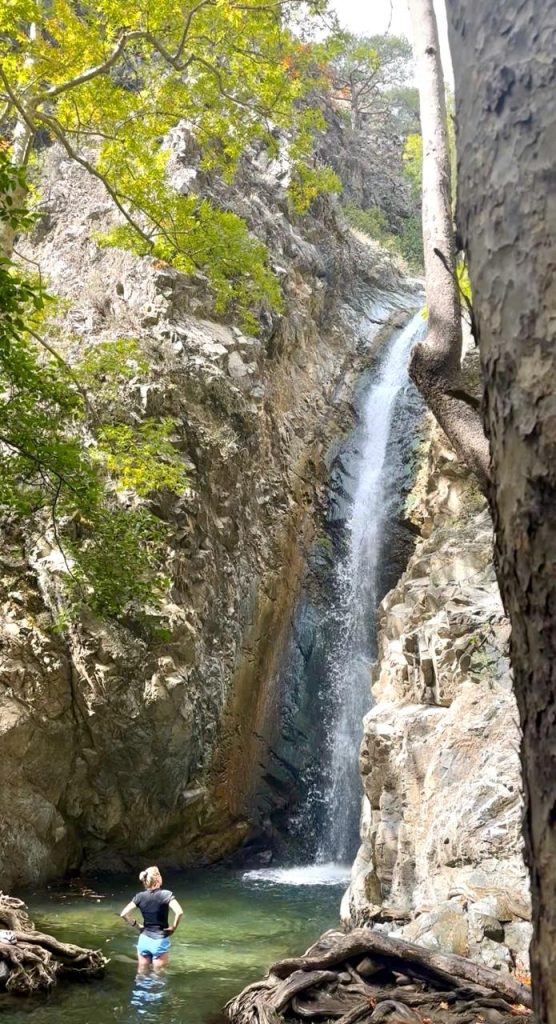
A Hike We Have Personally Done & Fully Recommend: Millomeris Waterfall Trail
If you want something shorter, Millomeris Waterfall Trail in Pano Platres is one we have personally done and fully recommend.
The official Cyprus Nature Trails map lists the route as:
1.2 km | approximately 30 minutes one way | Difficulty 3.
The trail begins between Faneromeni Church and the centre of Pano Platres, closer to the church.
It passes through lush vegetation alongside sections of the Kryos Potamos before reaching Millomeris Waterfall.
What we recommend is starting in Platres, walking down to the waterfall, spending some time there and then walking the same trail back up towards Platres.
Remember that the official 30-minute estimate is one way.
The return is uphill, so allow considerably more time if you are doing the route there and back.
Although the distance is short, it is officially rated Difficulty 3, so don’t underestimate the terrain.
Proper footwear is important, especially after rain.
For us, it is an excellent option if you want a genuine nature experience without committing to a three- or four-hour hike.
Official Cyprus Nature Trails Hiking Map
Platres: Don’t Finish Your Hike and Immediately Leave
Platres deserves some time of its own.
It is one of Cyprus’s historic mountain resorts and played an important role in the development of tourism in the Troodos Mountains.
After Millomeris, stay for lunch, coffee or even an overnight break.
Our Platres Recommendation: New Helvetia Hotel
One place we particularly recommend visiting is the New Helvetia Hotel.
It is much more than simply somewhere to stay.
The history of the property reaches back to 1906, when the Grand Hotel Helvetia was built on a pine-covered slope in Platres.
The hotel was expanded in 1929 and renamed New Helvetia.
Visit Cyprus describes it as the oldest operating hotel in Cyprus, maintaining a hotel tradition of more than a century.
The historic property retains characteristic red-brick architecture, tiled roofs, timber features and traditional furniture.
Even if you do not stay overnight, it is worth visiting for the atmosphere and for its connection with the history of Cyprus mountain tourism.
If you want to turn a Troodos day trip into a full weekend, staying in Platres gives you an entirely different Cyprus experience from the coast.
New Helvetia on the Official Visit Cyprus Historic Hotels List
Traditional Cypriot Food to Try After Moving to Cyprus
Food is one of the easiest ways to begin understanding the country you have moved to.
When visiting the villages around Limassol, look for traditional dishes such as:
- souvla;
- souvlaki;
- kleftiko;
- koupepia;
- afelia;
- halloumi;
- anari;
- lountza;
- village sausages;
- tahini;
- village salad; and
- Cyprus potatoes.
Try a Proper Cyprus Meze
If you have recently moved to Cyprus and have never had a proper traditional meze, start there.
Instead of ordering one dish, you receive a succession of dishes that introduce you to a much wider range of Cyprus flavours.
This is why we recommend the meze experience in villages such as Vouni.
Try Souvla on a Sunday
Souvla is one of the foods most closely connected with Cypriot Sundays, celebrations and family gatherings.
Large pieces of meat are slowly cooked over charcoal on a rotating spit.
One useful local tip:
Not every taverna serves souvla every day.
If this is specifically what you want, call the restaurant before travelling.
Where to Buy Traditional Cyprus Food & Drinks
One of the pleasures of a mountain day trip is returning home with local products.
Look out for:
- soutzoukos;
- kiofterka;
- arkatena;
- spoon sweets;
- grape syrup;
- carob syrup;
- local honey;
- Cyprus olive oil;
- halloumi;
- anari;
- lountza;
- village sausages;
- smoked meats;
- Commandaria;
- zivania; and
- local Cyprus wine.
Agros: Traditional Products, Roses & Smoked Meats
Agros is particularly good if you want to combine a mountain drive with shopping for traditional products.
The village is known for its rose products, traditional sweets and smoked meats.
It also works perfectly as part of a day trip combining Pelendri, Tsiakkas Winery, Kyperounta and Pitsilia.
Three Day Trips We Recommend From Limassol
1. The Limassol Wine Villages Day
Limassol → Lofou → Vouni → Omodos → Koilani → Vlassides Winery → Limassol
Start with Cyprus coffee in Lofou.
Continue through Vouni and stop for a traditional meze if you are ready for lunch.
Walk through Omodos and stop at Arkatena Fotini.
Finish in the Koilani area with a winery visit.
Don’t try to rush.
Three or four villages, one proper meal and one winery make a much better day than attempting to tick ten attractions off a list.
2. The Platres & Hiking Day
Limassol → Pano Platres → Millomeris Waterfall → Platres → New Helvetia → Troodos → Limassol
This is the route we recommend if you want nature without committing to a full-day hike.
Walk Millomeris down and back, spend some time in Platres and continue towards Troodos if you still have time.
3. The Pitsilia Wine & Food Day
Limassol → Pelendri → Tsiakkas Winery → Kyperounta → Agros → Limassol
This route is particularly enjoyable in autumn.
Combine wine tasting at Tsiakkas with local products in Agros and, if your visit coincides with an autumn festival, build the festival into the day.
Official Cyprus Resources Every New Resident Should Bookmark
If you have moved to Cyprus, it is worth knowing which online sources are official.
Republic of Cyprus – Deputy Ministry of Tourism
The Deputy Ministry of Tourism is the Republic of Cyprus government authority responsible for tourism.
Use its official resources alongside Visit Cyprus when planning rural trips, festivals and experiences.
Visit Cyprus
Visit Cyprus is the island’s official tourism portal.
It is particularly useful for:
- villages;
- wine routes;
- nature trails;
- festivals;
- cultural attractions; and
- traditional experiences.
Official Cyprus Wine Routes
Cyprus has seven designated wine routes covering different wine-producing regions of the island.
Limassol Wine Villages Route
Official Krasochoria of Limassol Wine Route
Pitsilia Wine Route
Cyprus Nature Trails
Official Cyprus Nature Trails Hiking Map
For mountain activities, always check conditions before travelling.
Weather and trail conditions at higher elevations can be very different from Limassol.
Moving to Cyprus? Understanding Your Immigration Route Comes First
Exploring Cyprus is the enjoyable part of relocation.
First comes the practical side.
The correct Cyprus residence permit or immigration route depends on factors including your nationality, employment, family circumstances and reason for moving.
EU/EEA/Swiss citizens and third-country nationals follow different immigration procedures.
At LaunchCy, we support individuals, families, founders, professionals and international companies moving to Cyprus, combining immigration and residence support with the wider practical relocation process.
Explore LaunchCy Cyprus Immigration Services
Moving to Cyprus as an EU Citizen?
EU, EEA and Swiss citizens intending to live in Cyprus for more than three months may need to complete the applicable residence registration process commonly referred to as the Yellow Slip or MEU1.
Our complete guide explains the requirements, documentation, costs and application procedure.
Yellow Slip Cyprus (MEU1) 2026 – Complete Guide
Moving to Cyprus as a Third-Country National?
Third-country nationals may require a different immigration route depending on their individual circumstances.
One option for eligible individuals is the Cyprus Temporary Residence Permit for Visitors, commonly referred to as the Pink Slip.
Cyprus Pink Slip / Temporary Residence Permit – Complete Guide
Considering Cyprus Permanent Residence?
Cyprus also offers permanent residence routes for qualifying third-country nationals, including the expedited route under Regulation 6(2).
Cyprus Permanent Residency – €300,000 Fast-Track Guide
Relocating a Company or Employees to Cyprus?
Companies moving founders, executives or employees to Cyprus have additional immigration, corporate, property and practical relocation considerations.
Business Relocation to Cyprus – Complete Guide
Moving to Cyprus Is About More Than a Residence Permit
Relocation is not complete when your immigration appointment is over.
It is complete when the country begins to feel like home.
Living in Limassol gives you access to two very different sides of Cyprus.
There is the international coastal city with its businesses, schools, restaurants and Mediterranean lifestyle.
Then, less than an hour away, there are vineyards, pine forests, waterfalls, wineries and villages where traditions surrounding food and wine have been passed from one generation to the next.
For newcomers, discovering both is part of understanding Cyprus.
So once your immigration formalities are under control, leave the city for a weekend.
Drink Cyprus coffee in Lofou.
Eat arkatena in Omodos.
Order a traditional meze in Vouni.
Taste Cypriot wine in Koilani and Pelendri.
Walk to Millomeris Waterfall.
Spend an afternoon in Platres.
Attend the Limassol Wine Festival.
Try fresh palouzes during the grape season.
That is when Cyprus begins to feel less like the country you moved to — and more like the place where you live.
Frequently Asked Questions About Moving to Cyprus & Living in Limassol
Is Limassol a good place to live when moving to Cyprus?
Limassol is one of Cyprus’s major international business and residential centres and attracts professionals, entrepreneurs, companies and families. It combines coastal city life with relatively easy access to beaches, mountain villages, wineries and Troodos. Whether Limassol is right for you ultimately depends on your budget, work, family requirements and preferred lifestyle.
What are the best wine villages near Limassol?
For a first visit, we recommend Omodos, Lofou, Vouni and Koilani. They can easily be combined into one day trip from Limassol. The official Krasochoria Wine Route includes 20 villages and 16 wineries.
What are the best wineries near Limassol?
Two of our recommendations are Vlassides Winery near Koilani and Tsiakkas Winery near Pelendri. Both offer an opportunity to discover Cyprus wine beyond standard restaurant wine lists, including indigenous Cyprus grape varieties.
What are the best things to do near Limassol in October?
October is particularly good for exploring wine villages, visiting wineries, hiking in Troodos and attending autumn festivals connected with wine, Commandaria, apples, grape products and other Cyprus traditions.
What can you do near Limassol in November?
November is ideal for mountain drives, traditional village lunches, winery visits and hiking when weather conditions are suitable. Pitsilia and the villages around Pelendri and Agros are particularly enjoyable at this time of year.
When is the Limassol Wine Festival?
In 2026, the Limassol Wine Festival runs from 26 September to 4 October at the Limassol Municipal Gardens. Dates vary each year, so check the Municipality of Limassol before attending.
What is a good short hiking trail near Limassol?
We personally recommend Millomeris Waterfall Trail from Pano Platres. The official Cyprus hiking map lists the route as 1.2 km and approximately 30 minutes one way, with Difficulty Level 3.
Where can I find official hiking trails in Cyprus?
The Cyprus Deputy Ministry of Tourism and Visit Cyprus provide official nature-trail resources showing route length, estimated duration, starting points and difficulty levels.
Where can I try traditional Cypriot food near Limassol?
The Limassol wine villages and Pitsilia region are excellent places to start. We recommend traditional arkatena and breakfast in Omodos, Cyprus coffee and mahalepi in Lofou, traditional meze in Vouni and regional products in Agros.
What are palouzes and soutzoukos?
Palouzes is a traditional dessert made from grape must. Soutzoukos is produced by threading almonds or walnuts onto string and repeatedly coating them with a thickened grape-must mixture before drying.
What residence permit do I need to move to Cyprus?
The correct Cyprus immigration route depends on your nationality, employment, income, family situation and reason for residence. EU/EEA/Swiss nationals and third-country nationals follow different procedures.
Do EU citizens need a Yellow Slip in Cyprus?
EU, EEA and Swiss nationals intending to reside in Cyprus for more than three months may need to complete the applicable residence registration procedure commonly referred to as the Yellow Slip or MEU1.
Read the LaunchCy Yellow Slip Cyprus Guide
What is the Cyprus Pink Slip?
The Cyprus Pink Slip is the commonly used name for the Temporary Residence Permit for Visitors available to eligible third-country nationals.
Read the LaunchCy Cyprus Pink Slip Guide
Can LaunchCy help me relocate to Cyprus?
Yes. LaunchCy provides Cyprus immigration and relocation services for individuals, families, professionals, founders and businesses moving to Cyprus. Support includes immigration and residence procedures as well as wider relocation assistance.
Explore LaunchCy Immigration & Relocation Services
About the Author
Stephania S. writes for LaunchCy on Cyprus relocation, immigration and the practical experience of settling into life on the island.
Her content combines immigration and relocation guidance with local recommendations designed to help newcomers understand Cyprus beyond the residence-permit process — from where to live and how to settle in, to the villages, food, traditions and experiences that make the island feel like home.
Disclaimer: Immigration requirements and government procedures can change. Immigration information should always be checked against the latest Republic of Cyprus Migration Department guidance and assessed according to the applicant’s individual circumstances.